Collision Repair Benchmarking
![]()
Headline Comparisons
(Latest Available)
 Sources:
- Australia: Insurance Council of Australia (March 2025 policy paper)
- USA: CCC Crash Course 2024/25; Rhode Island Insurance Division
(2024)
- UK: Repairer Driven News, Your Money UK Retail Charges Guide (WBDA,
2024)
- Germany: GDV 2024; ADAC context
Market-by-Market
Notes (Drivers)
Australia (NSW
Context)
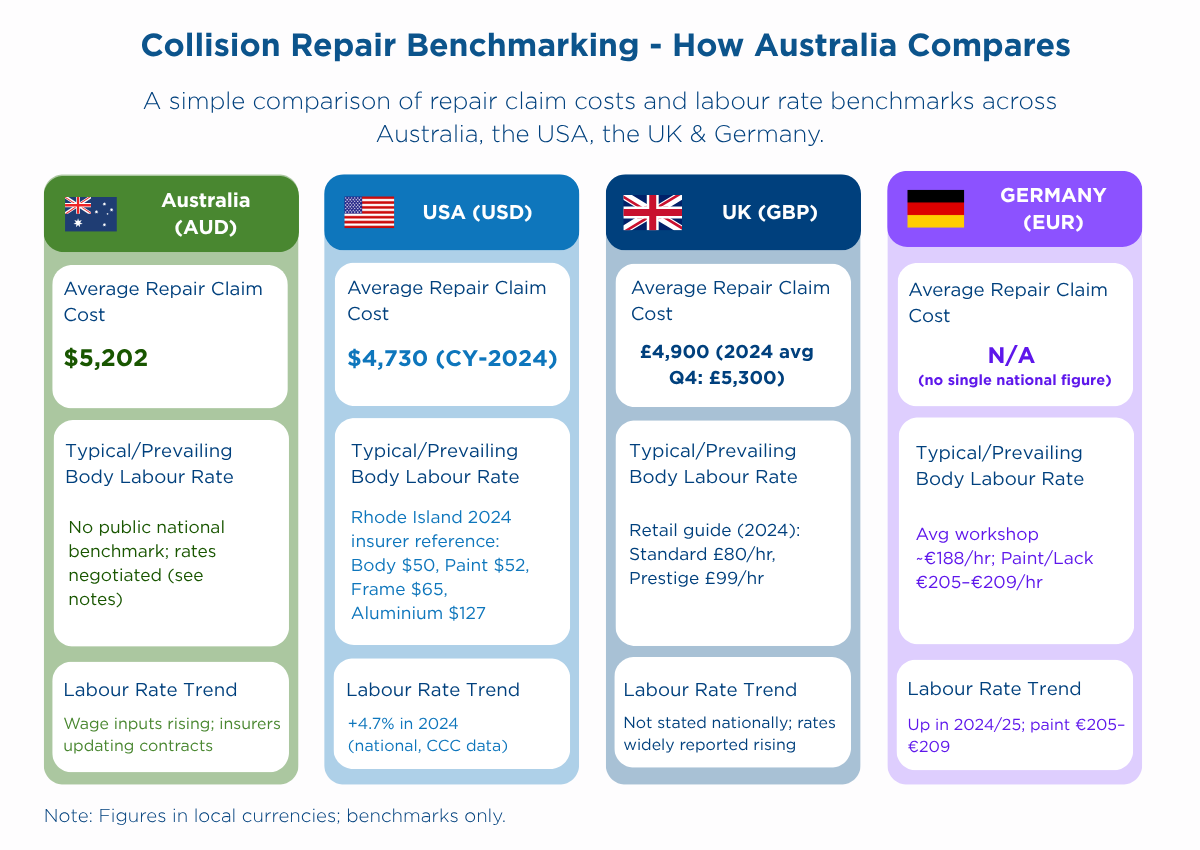
- Repair cost inflation: Average private-motor claim rose
from $3,658 (Jun-2019) → $5,202 (Jun-2024) — +42.2%. Driven by vehicle/parts
inflation, ADAS complexity, and labour inputs.
- Cost composition: Repairs now ~60% of claim costs;
repair costs up ~26% since 2022.
- Allowances/rates: No public “prevailing rate”.
Rates negotiated bilaterally. AMBRA/MTAA calculators derive
shop-specific rates. Typical panel beater wage: ~$29–$32/hr (not a shop
rate).
- Operational mix: Members have reported more labour
hours per repair due to increased complexity.
United States
- Repair costs: 2024 average TCOR >$4,730
(+3.7% YoY); Q1-2025 +1.1% YoY.
- Labour rates: CCC reports +4.7% national
increase in 2024.
- Allowances example: Rhode Island 2024 prevailing
rates — Body $50, Paint $52, Frame $65, Aluminium $127 (carbon fibre
~$87.90). Useful benchmark; varies by state.
United Kingdom
- Repair costs: 2024 average claim £4,900 (+13%
YoY); Q4 2024 £5,300. Total repair outlays: £7.7bn.
- Labour rates: Retail guide: £80/hr (standard),
£99/hr (prestige). Insurer allowances may differ.
Germany
- Labour rates: GDV reports average workshop
~€188/hr; paint/refinish €205–€209/hr.
- Trend: ADAC prior study ~€173/hr, showing upward
trajectory.
How to Use This
- Anchor local discussions: ICA data (+42% claim cost rise;
repairs = 60% of claims) supports updating labour/paint/material rates,
plus surcharges for diagnostics/ADAS calibration.
- International benchmarks: UK £80–£99/hr and Germany
€188–€209/hr show that mature markets support materially higher hourly
pricing than historic Australian norms.
- US insurer allowances: Use category-specific rates
(body vs aluminium vs frame) to structure proposals, even if Australia
lacks a public schedule.
- Methodology: Use AMBRA’s cost-based
calculator to derive defensible shop-specific hourly rates, factoring in
wages, overheads, equipment, and profit, alongside evidence of rising
claim costs and complexity.
Calculating Your Own
Labour Rate in a Panel Shop
A cost-based approach ensures your rate reflects actual
business costs and is defensible for insurers or clients.
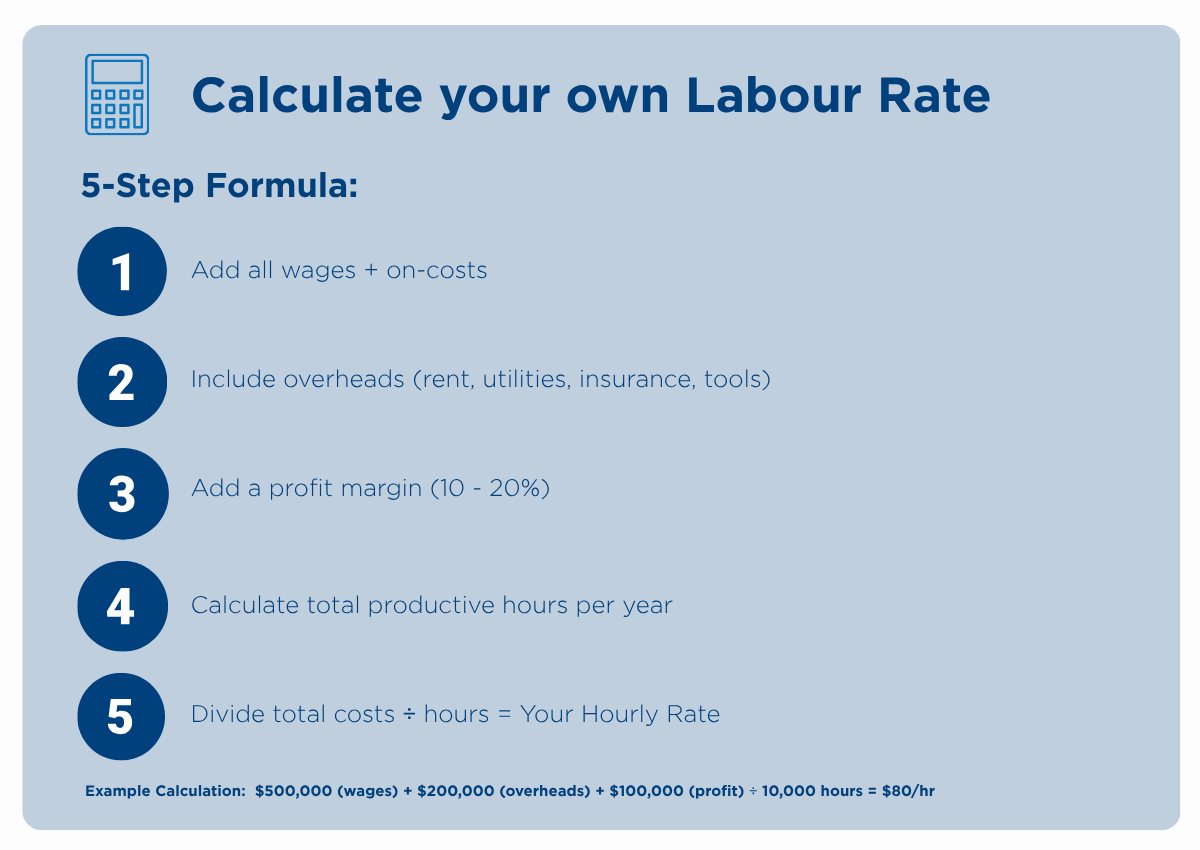
Step 1: Direct Labour Costs
- Include all production staff wages (panel, paint, prep) and on-costs
(superannuation, leave, payroll tax).
Step 2: Overheads
- Rent, utilities, insurance, IT, tools, equipment depreciation,
consumables — all costs necessary to operate the shop.
Step 3: Profit Margin
- Add a sustainable profit margin (typically 10–20%).
Step 4: Available Labour Hours
- Total productive hours per year for all staff, subtracting holidays,
training, downtime, and non-productive time.
Step 5: Hourly Rate Calculation
Example:
- Total annual labour cost: $500,000
- Labour rate: (500,000 + 200,000 + 100,000) /
10,000 = $80/hr
Recalculate annually or when costs change to keep rates
accurate and defensible.
Disclaimers
- Not like-for-like: Definitions, tax/VAT, insurer
networks, and labour categories differ. Figures are directional
benchmarks.
- Currency: Shown in local currencies to avoid FX distortion.
- Australia’s rates: No public national allowance
exists; use cost-based derivations and third-party trend data (ICA) to
support revisions.
< Back to News